

Iran Says It Will Pause Strikes — What’s Actually Going On, Explained Simply. Been half-following the Iran news between meetings and emails? People say that its confusing. One headline says “US strikes Iran.” Next one says “ceasefire.” Then it’s “strikes resume.” Now everyone’s saying “pause” again If you don’t watch the news, you’ll be left wondering what’s going on… So let’s slow down and walk through what this latest “pause” actually means, why it happened, and — maybe more importantly — why almost nobody involved seems to think it’ll last.
Will the Pause Lead to a Ceasefire?
.The US is saying it will stop attacking Iran, but the truth is still out there. But the “why” behind it is where things get interesting. How we got here https://www.aljazeera.com/
Iran’s announcement came shortly after the United States paused its own airstrikes. According to reports, US officials advised President Donald Trump to temporarily stop the attacks because many of the planned military targets had already been hit. They were also concerned about using too many weapons in a short period.
For nearly two weeks, the US carried out airstrikes almost every night. After 13 consecutive nights of attacks, the Pentagon decided to pause the operation late on Friday. No new US airstrikes were reported over the weekend, giving the region a short break from the fighting.
Iran, which had been responding to each night of US strikes with its own attacks on neighboring countries hosting US military bases, also held off for two consecutive days.
So both sides quietly stopped shooting at roughly the same time. Neither one wanted to be the one to blink first and call it a “ceasefire” outright — that word carries weight, and nobody wants to be seen as backing down. Instead, you get this awkward, unofficial mutual pause where everyone’s watching everyone else.
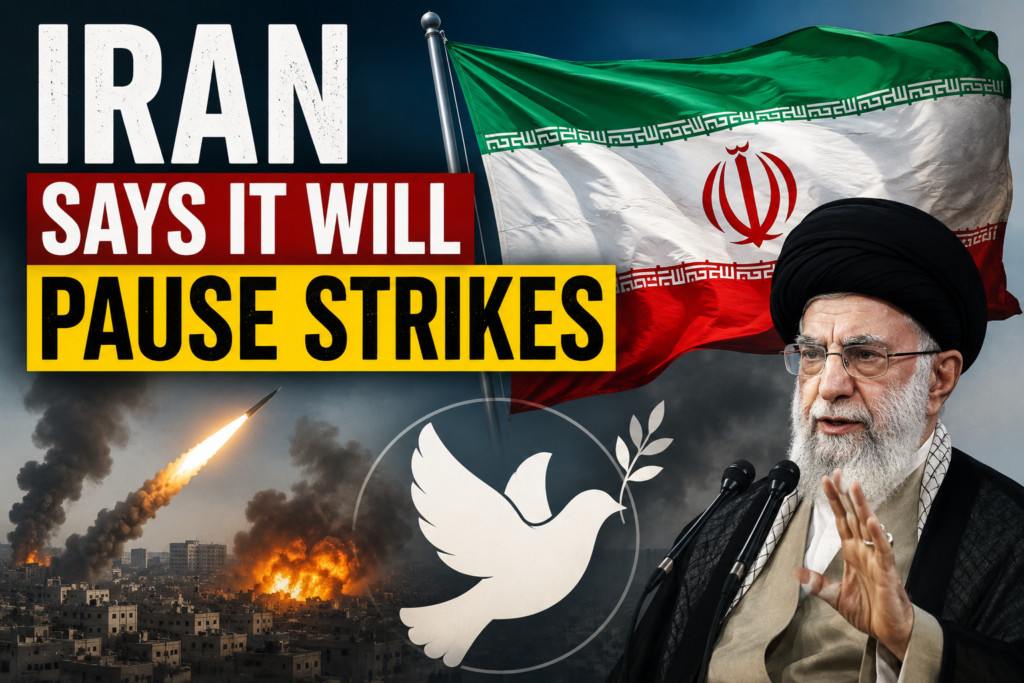
What Happens After Iran Says It Will Pause Strikes 2026.
Here’s the part that actually matters if you want to understand where this goes next: the Iranian source said Tehran doesn’t hold much hope that Trump’s decision to pause strikes represents any real shift in the US negotiating position.
According to that same Iranian official, there’s more skepticism than optimism inside Iran about the halt in attacks — the prevailing view is that it’s tactical, not genuine, because Iran has “accumulated enough bitter experience” with what it sees as US deception.
Many people are still being careful. They think this is only a break in the fighting, not a real peace deal.
And honestly, that skepticism isn’t coming from nowhere. Regular people are feeling it too. Nader, a 49-year-old import-export business owner in Tehran, told Reuters he doubted any pause would last, saying everyone in the country is “stuck in limbo”. His exact frustration, in his words, was that Trump is “playing games” — neither ending the war and leaving the region, nor striking decisively. That’s a civilian’s perspective, and it captures the exhaustion a lot of people over there are dealing with — not knowing whether tonight is a quiet night or not.
Iran Says It Will Pause Strikes
Iran Says It Will Pause Strikes — Aakhir Ho Kya Raha Hai?
Over the past several days, tensions across the Middle East had reached one of their highest levels in recent months. Now, the situation appears to be taking a different turn after Iran announced that it would pause its strikes.
According to a Reuters report from Dubai and Washington, a senior Iranian official said Tehran is prepared to halt its attacks as long as the United States also keeps its bombing campaign on hold. The official shared this information with Reuters on Sunday.
The announcement follows nearly two weeks of intense military activity. For 13 consecutive nights, US forces carried out airstrikes on Iranian targets. However, the Pentagon unexpectedly suspended the campaign on Friday night, and no new US strikes were reported on Saturday or Sunday.
The decision did not come out of nowhere. Reports suggest that during a high-level meeting on Friday, President Trump’s senior military and political advisers raised serious concerns about continuing the operation. One of the key issues discussed was the growing pressure on US missile stockpiles, which reportedly influenced the decision to pause the campaign.
The bigger question now is whether this pause is the first real step toward de-escalation or simply a tactical break in the fighting.
Iran remains deeply sceptical. According to a source familiar with Tehran’s position, there is little confidence that the pause will last, with many officials viewing it as a strategic move rather than a genuine effort to reduce tensions.
The United States, however, has presented a different perspective. US Ambassador Mike Waltz described the pause as an opportunity to create space for diplomacy, suggesting that both sides now have a chance to avoid further escalation through dialogue instead of continued military action.
Ordinary people are also feeling the uncertainty. Speaking to Reuters, a shopkeeper in Tehran said the entire country feels stuck in limbo, adding that many people believe President Trump is “playing games” rather than working towards a lasting solution.
For now, the situation remains fragile. Much will depend on developments over the coming days, particularly the upcoming meeting between Israeli Prime Minister Benjamin Netanyahu and President Trump. That meeting could determine whether this pause becomes the beginning of a broader diplomatic effort or simply the calm before another round of conflict.
The condition attached to the pause
Iran isn’t pausing unconditionally. The Iranian official said Tehran’s position remains “attack for attack” — if the US attacks stop, Iran halts its operations too, and that message has already been passed along to Washington. That’s the whole logic hereThis isn’t a formal peace agreement where both sides have signed a deal. It’s simply a temporary pause in the fighting. The main problems are still there, and nothing has been fully resolved. If either side starts attacking again, the other is likely to respond quickly
What was actually being fought over
If you’re just catching up on the story, here’s a quick summary. Over the past two weeks, the United States carried out airstrikes on Iran almost every night. US officials said the attacks were a response to Iranian actions against ships in the Strait of Hormuz.
Iran, on the other hand, responded with its own strikes. Reports said some of those attacks targeted water desalination plants in nearby Gulf countries, adding to concerns that the conflict could spread across the region.
. Iran says it wants to retain control of the strait, which normally carries around a fifth of global oil that passes through it — so this isn’t just a regional squabble, it’s tied to a chokepoint that affects oil prices and shipping insurance costs worldwide. If you’ve noticed gas prices twitching around lately, this is part of why.
Worth noting too — this renewed campaign effectively blew up an interim agreement from the previous month that had been aimed at ending the war. So this isn’t the first time things looked like they were calming down before flaring back up.
Will the Pause Lead to a Ceasefire?
Here’s a date worth circling if you want to actually track where this goes: Israeli Prime Minister Benjamin Netanyahu is scheduled to meet with Trump on Tuesday in Washington. Speaking to Fox News, Netanyahu said the conflict with Iran will only end when the Iranian government is “either toppled or sufficiently weakened that it knows it has to end its nuclear program,” adding that “with a deal or without a deal,” Iran’s nuclear program has to stop.
That’s a pretty maximalist position, and it tells you this “pause” is nowhere close to a resolution. It’s a ceasefire in behavior, not in intent.
Also worth flagging: General Dan Caine, the chairman of the Joint Chiefs of Staff, has privately warned Trump that resuming large-scale operations carries real risk because of the strain on US munitions stockpiles — including interceptor missiles used for air defense. So part of why this pause exists isn’t diplomacy at all — it’s logistics. The US is genuinely worried about running low on the missiles it’d need to defend against Iranian retaliation if things escalate again.
What this actually means if you’re just trying to follow along
If you want the practical takeaway without doom-scrolling every hour:
- This is not a ceasefire agreement. No treaty, no handshake, no signed terms.
- It’s a mutual, informal stand-down that either side can end at any moment.
- The trigger for resumed fighting would likely be either side perceiving the other as violating the “quiet.”
- Tuesday’s Trump-Netanyahu meeting is the next real thing to watch — it could shape whether this pause turns into something more formal, or gets torn up entirely.
- Oil markets and shipping through the Strait of Hormuz are the practical things that ripple out from this into everyday life, even far from the region.
A quick personal note on reading this kind of news
One thing this situation has shown is that the words leaders use are important. When officials say “pause” instead of “ceasefire,” it usually means the fighting has stopped only for now. It doesn’t mean the conflict is over or that a peace agreement has been reached.
Diplomatic language is precise on purpose. When even the people closest to the situation — like that Tehran business owner — are calling it “limbo,” that’s about as honest an assessment as you’re going to get.
Worth checking back in after Tuesday’s meeting, since that’s genuinely the next moment that could tip this one way or the other.