
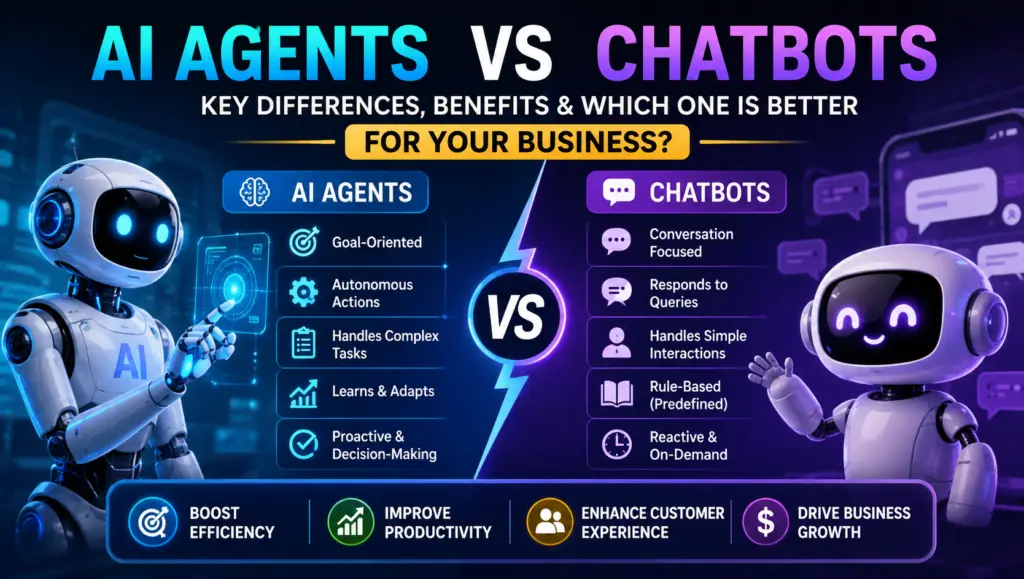
AI Agents vs Chatbots both use artificial intelligence to communicate with users, but they work differently. AI chatbots mainly answer questions and handle conversations using conversational AI, natural language processing (NLP), natural language understanding (NLU), machine learning, large language models (LLMs), and generative AI models. They are commonly used as AI assistants, virtual assistants, digital assistants, and conversational agents for customer support and routine tasks.
The main difference in AI agents vs chatbots is that an AI agent can go beyond conversation. AI agents use agentic AI, autonomous AI, intelligent agents, and intelligent automation to understand goals, make decisions, use tools, and complete multi-step tasks through AI-powered systems. In simple terms, a chatbot mainly responds, while an AI agent can reason, plan, and act, making the AI agents vs chatbots comparison important for businesses choosing the right technology.
Table of Contents
Chatbot Definition & Characteristics
A chatbot is a software system designed to communicate with users through text or voice and provide automated responses to user prompts. A traditional chatbot, rule-based chatbot, or scripted chatbot typically relies on predefined rules, decision trees, conversation flows, dialogue flows, and predefined workflows to determine what response should come next. This chatbot technology is commonly used in chatbot software, FAQ chatbot systems, customer service chatbot solutions, and conversational chatbot platforms for answering frequently asked questions, handling simple queries, and supporting information retrieval.
Modern AI-powered chatbot systems can be more flexible, but many chatbots still operate as a reactive system that responds to specific inputs rather than independently completing complex goals. They are effective for basic customer support, routine interactions, and repetitive tasks, especially when predefined responses or scripted responses are sufficient. However, common chatbot limitations include limited context, limited flexibility, and fixed conversation paths when dealing with requests outside their rule-based dialogue or established conversation structure.
Visit this also: Best AI Productivity Tools in 2026 | Top AI Apps for Work & Automation
AI Agent Definition & Characteristics
An AI agent is an intelligent software system designed to understand a goal, plan the required steps, and take action with limited human intervention. An autonomous agent, autonomous AI agent, or intelligent AI agent can use AI reasoning, machine reasoning, contextual understanding, and contextual awareness to handle complex problem solving and multi-step tasks. Unlike a basic chatbot, a goal-oriented AI or goal-oriented agent focuses on goal achievement, using action planning, decision-making, and independent planning to determine how a task should be completed.
An agentic system or agentic AI agent can demonstrate proactive AI behavior by taking independent action, adapting to changing information, and completing task execution without requiring instructions for every step. These capabilities make AI agents useful for task automation, workflow automation, and intelligent automation. With adaptive behavior, dynamic conversations, and personalized interactions, AI agents can provide more human-like conversations while maintaining the ability to plan, act, and adjust their approach as a situation changes.

Key Differences Between AI Agents vs Chatbots
The AI agents vs chatbots comparison becomes clearer when you look at how each system handles decisions, context, and actions. Chatbots are generally better for predictable conversations and straightforward requests, while AI agents are designed for reasoning, planning, and completing more complex workflows.
| Features of AI agents vs chatbots | Chatbots | AI Agents |
|---|---|---|
| Core approach | Rules vs reasoning — often follows predefined logic | Uses reasoning, planning, and AI agent capabilities |
| Behavior | Reactive vs proactive — responds after a user prompt | Can act proactively toward a goal |
| Conversation style | Scripted vs dynamic | Dynamic and context-aware |
| Workflows | Predefined workflows vs autonomous workflows | Can plan and adapt workflows independently |
| Task complexity | Simple tasks vs complex tasks | Better suited to complex, multi-step tasks |
| Primary function | Answering questions vs taking action | Can take action using tools and connected systems |
| Output | Conversational responses vs task execution | Combines conversation with task execution |
| Responses | Fixed responses vs contextual responses | Generates responses based on context and goals |
| Context | Limited context vs contextual understanding | Can maintain and use broader contextual understanding |
| Interaction | User-driven interaction vs proactive behavior | Can proactively identify and perform next steps |
| Automation | Rule-based automation vs agentic automation | Uses agentic automation for adaptive workflows |
| Support | Basic support vs advanced support | Better for advanced support and complex processes |
| Problem solving | Information retrieval vs problem solving | Can reason through problems and determine actions |
| Workflow control | Conversation management vs workflow orchestration | Can coordinate multiple steps, tools, and processes |
| Limitations | More affected by chatbot limitations, fixed logic, and narrow workflows | Generally offers broader flexibility and autonomy |
AI Agent Tools & Actions
AI agents can use AI tools, tool calling, external tools, API integrations, and system integrations to perform tasks beyond conversation. They can access databases, CRM systems, enterprise applications, workflow systems, and business systems through API calls and backend integrations.
With tool orchestration and workflow orchestration, agents can perform automated actions, task automation, and process automation. They can handle data retrieval, data processing, transaction handling, information lookup, and other backend operations, turning user requests into real system actions and completed tasks.
Knowledge, Data & Context
AI agents can work with business data, enterprise data, and customer data from sources such as structured data, unstructured data, databases, spreadsheets, documents, PDFs, emails, and chat logs. By connecting to a knowledge base containing company knowledge and proprietary data, they can retrieve relevant information and provide more useful, grounded responses.
Modern agents can use data grounding, AI grounding, and retrieval augmented generation (RAG) to combine external knowledge with contextual information. With data access, knowledge retrieval, real-time data, and historical data, they can use customer records when needed. Context retention, conversation history, memory, and persistent context also help agents maintain continuity across interactions.

Customer Service & Contact Center Use Cases of AI Agents vs Chatbots
AI agents and chatbots are transforming customer service, customer support, and the contact center by automating customer inquiries, support automation, and routine customer requests. Chatbots are useful for conversational customer service, FAQs, and 24/7 support, while AI agents can provide personalized customer service, handle customer issue resolution, and support case management and ticket handling. A virtual customer service agent can also deliver digital customer service across multiple channels.
For larger operations, call center automation and contact center automation can manage inbound support, outbound calling, and agent assistance. These solutions support CX automation and customer service automation by reducing repetitive work, reduced wait times, and improving faster response times. When routine issues are resolved quickly and complex cases are handled more efficiently, businesses can improve overall customer experience (CX) and customer satisfaction.
AI Agent Use Cases
AI agents can handle a wide range of tasks by combining reasoning, tool use, and automation. Common AI agent use cases include:
- Task automation — handling repetitive tasks with minimal human input.
- Workflow automation — coordinating multiple steps across business systems.
- Customer service automation — resolving customer questions, requests, and cases.
- Sales automation — supporting lead qualification, follow-ups, and sales prospecting.
- Marketing automation — managing customer engagement and personalized campaigns.
- Business process automation — streamlining complex internal processes.
- Case resolution — investigating issues and taking appropriate actions.
- Claims processing — reviewing information and assisting with claim workflows.
- Appointment scheduling — checking availability and booking appointments.
- Order management — tracking, updating, and processing customer orders.
- Information retrieval — finding relevant information from connected knowledge sources.
- Data analysis — analyzing large datasets and generating useful insights.
- Document processing — extracting, organizing, and processing information from documents.
Visit this also: How to Get Better Answers From ChatGPT: A Complete Prompt Guide
Chatbot Use Cases
Chatbots are especially effective for FAQ automation, basic customer support, and repetitive customer interactions. Common chatbot use cases include:
- FAQ bot — answering routine questions with automated FAQ responses.
- Information gathering — collecting basic details through a conversational interface.
- Lead collection — capturing visitor information and potential leads.
- Document collection — requesting and organizing required customer documents.
- Identity verification — supporting ID verification during customer interactions.
- Customer inquiries — responding to common questions and simple requests.
- Predefined tasks — completing straightforward tasks based on predefined workflows.
- Scripted support — providing consistent answers for standard support scenarios.
- Website chatbot — assisting visitors directly on a website.
- Support chatbot — handling common service requests before human escalation.
- Website customer service — providing quick assistance to website visitors.
- Routine customer interactions — automating repetitive conversations and reducing the workload on support teams.

Performance, Benefits & Business Value of AI Agents vs Chatbots
Both AI Agents vs Chatbots can deliver significant automation benefits, but their business value differs based on task complexity and autonomy. Chatbots are effective for reducing repetitive work and call volume, while AI agents can optimize entire workflows and processes, improving operational efficiency, productivity, and business efficiency.
| Area | Chatbots | AI Agents |
|---|---|---|
| Operational efficiency | Handles routine tasks | Optimizes complex workflows |
| Productivity | Supports employee productivity | Automates multi-step work |
| Cost reduction | Reduces support workload | Delivers broader cost reduction |
| Workload | Provides reduced workload for support teams | Automates larger portions of business processes |
| Response speed | Offers faster response times | Enables faster responses and faster issue resolution |
| Customer satisfaction | Improves basic support experiences | Can deliver improved customer satisfaction and service quality |
| Scalability | Supports high volumes | Provides greater enterprise scalability |
| Availability | Offers 24/7 availability | Can operate continuously across workflows |
| Workflow optimization | Limited to predefined workflows | Enables advanced workflow optimization |
| Process efficiency | Improves simple processes | Enhances overall process efficiency |
| Business efficiency | Useful for routine operations | Supports broader business efficiency |
| Return on investment | Strong for focused automation | Potentially higher return on investment for complex processes |
| AI adoption | Easier starting point for AI adoption | Supports advanced AI adoption and digital transformation |
Choosing Between an AI Agents vs Chatbots
The right choice depends on your business requirements, customer needs, and the type of work you want to automate. During AI agents vs chatbots selection, consider task complexity, automation requirements, workflow complexity, integration requirements, security requirements, scalability, budget, and implementation time. For simple use cases such as FAQs and basic customer support, a chatbot may be the best-fit AI solution. For complex use cases involving planning, decision-making, and multi-step actions, an AI agent is usually more suitable.
Before choosing an AI Agents vs Chatbots, evaluate your customer service goals and enterprise requirements. Reviewing AI agents vs chatbots use cases can help determine whether your organization needs conversational support or greater autonomous automation. Some businesses can benefit from a hybrid AI strategy or composite AI approach, using chatbots for straightforward interactions and AI agents for complex workflows. This approach can provide flexibility while matching each task with the most appropriate technology.
Frequently Asked Questions About AI Agents vs Chatbots
What is the difference between AI agents and chatbots?
AI agents can reason, plan, use tools, and complete multi-step tasks, while chatbots mainly respond to user questions and handle predefined or conversational interactions.
Is an AI agent better than a chatbot?
An AI agent is better for complex tasks, workflow automation, and autonomous decision-making. A chatbot is often the better choice for FAQs, basic customer support, and simple requests.
Can AI agents replace chatbots?
AI agents can handle many chatbot functions, but they do not necessarily replace chatbots. Businesses can use chatbots for routine conversations and AI agents for complex tasks that require actions and decision-making.
What are the main use cases for AI agents vs chatbots?
Chatbots are commonly used for FAQ automation, customer inquiries, lead collection, and basic support. AI agents are used for task automation, workflow management, data analysis, customer service automation, and complex problem solving.
Should my business use an AI agent or a chatbot?
Choose a chatbot for simple, predictable interactions and an AI agent for complex, multi-step workflows. A u003cstrongu003ehybrid AI strategyu003c/strongu003e can also combine both technologies based on your business requirements and automation goals.

