
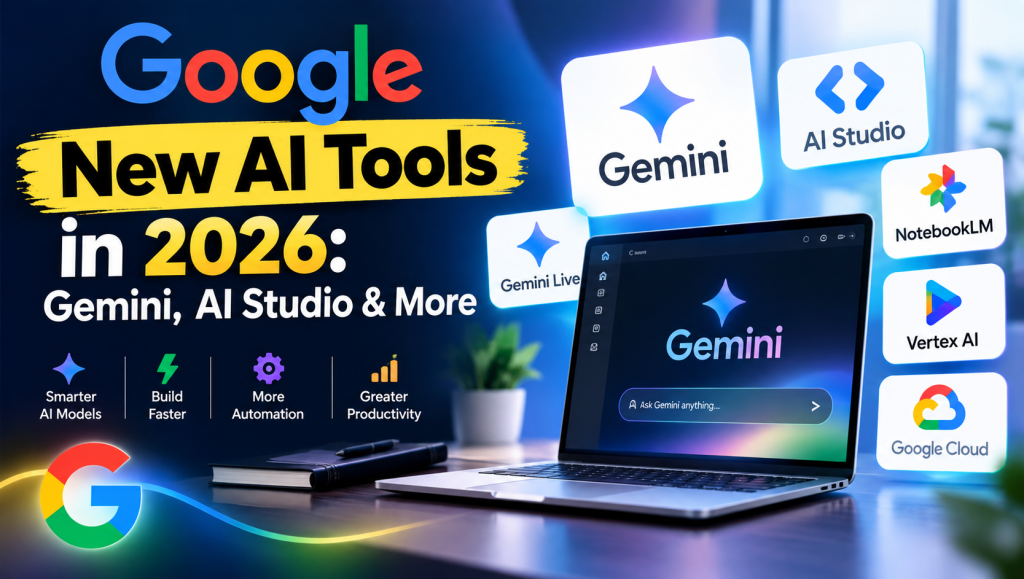
If you have only used Google AI tools for basic questions, there is much more to explore. New Google AI tools now support research, writing, coding, learning, image creation, and productivity. From Google Gemini and Gemini AI to other Google AI products, these AI-powered tools use generative AI, machine learning, and multimodal AI to handle different types of tasks.
Google is also expanding its Google AI platform, Google Cloud AI, and Google AI services with practical AI applications for individuals, creators, developers, and businesses. Alongside advanced Gemini models, users can find free AI tools, free Google AI tools, and Google AI experiments that showcase the company’s latest artificial intelligence and AI innovation.
Table of Contents
Gemini & Generative AI
Gemini is at the center of Google’s generative AI ecosystem, combining a Gemini AI assistant with increasingly capable Gemini models for everyday and professional tasks. Through the Gemini app, users can work with text, images, audio, video, and documents, while multimodal AI enables the models to understand different types of information together. These capabilities support text generation, image generation, code generation, research, and broader content creation.
For developers, Google AI Studio provides a place for AI experimentation, AI model testing, and AI prototyping, while the Gemini API and Gemini Developer API provide access for building applications. Developers can use AI prompts and prompt engineering to guide outputs, explore reasoning models, and create generative AI applications such as an AI chatbot, conversational AI assistants, research tools, and coding applications. Google’s current API also supports multimodal inputs, image generation, tools, agents, and structured outputs, making it useful for broader AI development.

AI Coding & Developer Tools
Gemini Code Assist is an AI coding assistant that helps with code completion, code generation, code debugging, code refactoring, and everyday coding assistance. It supports IDE integration with VS Code and JetBrains IDEs, making software development and application development faster.
Gemini CLI brings AI into the command line interface for terminal workflows, shell scripts, and local development. Google Antigravity adds AI agents and sub-agents for code automation, while Google’s developer API can support frontend development, full-stack development, and other developer tools.
AI Research, Study & Productivity
NotebookLM, now called Gemini Notebook, works as an AI research assistant and personalized study assistant for working with uploaded documents, notes, research papers, and other sources. It can provide source-based answers, summaries, insights, and document analysis, making it useful for academic research, content analysis, and information synthesis.
For students and professionals, Gemini Notebook also offers Audio Overviews, study materials, quizzes, flashcards, and interactive learning features. These research tools, combined with knowledge management, AI-powered research, and other productivity tools, can make complex information easier to understand and organize.
Visit this: Best AI Educational Tools to Improve Learning and Teaching
AI Audio, Speech & Voice Tools
- Speech-to-Text: Google’s AI can convert spoken audio into written text with language detection, speaker identification, timestamps, and transcription support.
- Text-to-Speech: Gemini and Google Cloud tools can turn text into natural-sounding speech, supporting expressive AI voice, different languages, and single- or multi-speaker audio.
- Speech Recognition: Google’s speech recognition models can handle multilingual speech and different accents, making them useful for audio transcription and voice-based applications.
- Voice & Audio AI: Gemini’s audio capabilities support speech analysis, audio processing, voice assistants, and voicebots, while AI audio tools can help with transcription and accessibility.
- Synthetic Speech: Google’s newer TTS models provide controllable synthetic speech, including voice style, accent, pace, tone, and emotional expression.
AI Image & Visual Tools
Google AI image tools now cover both AI image generation and advanced image analysis. Google Cloud’s Vision AI combines computer vision and visual AI for tasks such as object detection, image recognition, image labeling, face detection, landmark detection, and logo detection.
For documents and visual content, Cloud Vision AI supports text recognition and OCR, while visual search and product search can help identify and find visual items. These capabilities provide image understanding and AI-powered image analysis for applications that need to process and interpret images automatically.

AI Translation & Language Tools
Google Translate AI and Google Cloud’s translation services use AI translation, machine translation, and neural machine translation (NMT) to translate content across many language pairs. The Translation API is available in Translation API Basic and Translation API Advanced editions, with features such as automatic language detection, real-time translation, and support for multilingual applications.
- AI Translation & NLP: Google’s multilingual AI uses natural language processing (NLP) to understand and translate text across supported languages.
- Document Translation: Advanced supports document translation and formatted document translation, preserving much of the original layout and formatting.
- Translation Glossary: Businesses can use a translation glossary to keep product names and industry-specific terminology consistent.
- Batch Translation: Advanced supports batch translation for processing larger amounts of content from Cloud Storage.
- Localization: These tools can support text localization, multilingual websites, applications, and real-time translation workflows.
Visit this also: AI Marketing Tools for Bloggers to Create, Promote & Grow Content
AI Text & Language Analysis
Google Cloud’s Natural Language API provides natural language understanding (NLU) for analyzing unstructured text. Its features include sentiment analysis, entity analysis, entity sentiment analysis, content classification, and syntax analysis, making it useful for understanding the meaning and structure of written content.
For developers, these natural language processing tools can perform text analysis, semantic analysis, text classification, and broader language processing tasks. Google’s AI language models can complement these capabilities when building applications that need to understand, organize, and process large amounts of text.
Google Cloud AI & Developer Services
Google Cloud AI provides a broad range of Google Cloud AI tools, AI APIs, and cloud AI services for building and deploying intelligent applications. Services such as Cloud Vision, Speech-to-Text API, Text-to-Speech API, Natural Language API, Video Intelligence API, and Translation API handle image, speech, text, video, and language tasks.
For developers, Google Cloud also provides an AI development platform, machine learning models, and AI infrastructure for moving from AI prototypes to production-ready AI. Compute Engine supplies virtual machines, while Cloud Storage provides scalable object storage. Together, these services support AI deployment, cloud computing, and different stages of the machine learning lifecycle.

Free Google AI Tools & Pricing
| Google AI Tools | Free Access | Best For |
|---|---|---|
| Gemini | Free plan with usage limits | Chat, writing, research |
| Google AI Studio | Free tier for selected models | AI prototyping |
| NotebookLM | Free plan with limits | Research and study |
| Gemini Code Assist | Free plan with usage limits | Coding |
| Gemini API | API free tier for selected models | AI development |
| Google Cloud | $300 free credits for eligible new users | Cloud AI projects |
These free Google AI tools, free AI software, free AI apps, and free developer tools can help users test AI without immediately paying. However, monthly limits, usage limits, free credits, and eligibility vary by service. Some AI APIs also provide a free tier, while Google Cloud’s $300 credits have separate eligibility requirements.
Visit this also: 15+ AI Deepfake Detection Tools: Detect Fake Images, Videos & Audio
AI Agents & Automation
Google AI tools is moving beyond traditional chatbots with AI agents and agentic AI that can complete multi-step tasks. Google AI agents can support AI automation, workflow automation, and AI-powered workflows, while the Gemini Enterprise Agent Platform provides tools for building and managing these systems.
Developers can create customizable AI agents, use Agent Garden and agent blueprints, and connect multiple agents through multi-agent systems. These capabilities support task automation, AI-assisted development, intelligent automation, and more flexible AI workflows for businesses and developers.
Frequently Asked Questions About Google AI Tools
What are the new Google AI tools?
New Google AI tools include Gemini, Gemini Notebook, Google AI Studio, Gemini Code Assist, Gemini CLI, and AI agent tools. They support tasks such as research, coding, content creation, app development, and automation.
What is Google Gemini used for?
Google Gemini is an AI assistant that can help with writing, research, learning, coding, image and video tasks, and other everyday activities. Google has also added more agentic features to Gemini for completing multi-step tasks.
What is Gemini Notebook?
Gemini Notebook, formerly called NotebookLM, is Google’s research and learning tool. It can work with your sources, help analyze information, and create study materials such as summaries, quizzes, flashcards, and video overviews.
Which Google AI tool is best for developers?
Google AI Studio, Gemini Code Assist, and Gemini CLI are designed for different developer workflows. AI Studio supports AI prototyping and app building, while Code Assist and Gemini CLI provide AI-powered coding assistance.
Are Google AI tools free?
Some Google AI tools offer free access or free tiers, but available features, models, and usage limits vary. Google AI Studio, for example, provides free deployment for a user’s first two apps under its stated conditions.
Conclusion
The latest Google AI tools show how quickly Google is expanding its AI ecosystem with new AI features, advanced AI models, and next-generation AI experiences. From Gemini’s multimodal understanding and AI reasoning to AI-powered applications, Google is combining generative AI technology, machine learning, deep learning, computer vision, natural language processing, and speech recognition across its products.
For developers and everyday users, AI agents, AI automation, AI development, and AI experimentation are becoming important parts of Google’s tools. These capabilities can support AI-powered productivity, app development, research, coding, and creative work, while Google’s expanding agent platforms provide new ways to turn ideas into practical applications.

